
Case study · B2B SaaS · Fleet operations
Custom Reports Builder
Enhanced analytics & reporting for fleet management — turning massive operational data into actionable insights for fleet managers.
- Role
- UX research lead
- Timeline
- Discovery Jan–Mar 2024 · Evaluative Apr–Jun 2024 · Beta Q2 2025
- Team
- Sr. UX designer, Staff PM; regular exec readouts
- Methods
- Desk research, competitive analysis, analytics, interviews, concept & usability testing
Background & challenge
User need
Customers needed more actionable insights to streamline workflows. Data was buried and hard to manage at scale.
Business challenge
Alongside 10+ legacy dashboards, leadership planned 15–20 net-new dashboards by 2027. Without a strategy for surfacing data coherently, UX risked becoming even more fragmented.
My role
As UXR lead I clarified the problem space and business goals, planned and ran foundational and evaluative research, and partnered with stakeholders from insight through launch.
Physical operations run on enormous telemetry and event data — the product had to make that data discoverable, trustworthy, and useful for fleet managers who are not analytics specialists.
Outcomes at a glance
- Leadership approved and funded design and engineering work on new reporting capabilities based on critical needs surfaced in discovery.
- Evaluative research helped the team iterate toward general availability; Advanced Custom Reports (ACR) launched to Beta customers in Q2 2025.
- The release was positioned as a major contributor to ACV within the broader product portfolio.
What we shipped
More comprehensive, discoverable datasets
Simplified reporting workflows
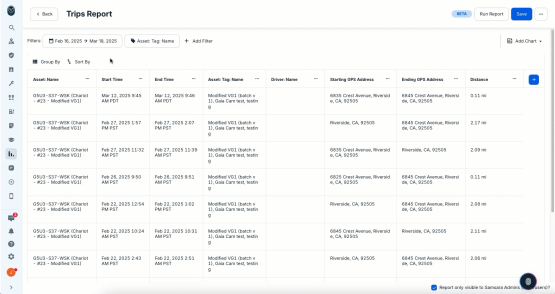
AI-assisted report creation, dynamic charts, and trend tracking
Research process
A phased approach moved from understanding the problem and business goals through evaluative cycles that de-risked launch.
- 01
Foundational
Understand problem & goals
- 02
Discovery
Desk research & synthesis
- 03
Evaluative
Concept & usability testing
- 04
Build + iterate
Heatmaps, refinement, Beta
Desk research
Goals
- Evaluate existing research to inform new discovery
- Consolidate dispersed customer feedback for stakeholders
Methodology
- Synthesized prior user research, support tickets, sales calls, and feature requests
- Organized findings by themes to focus downstream interviews
Outcomes
- Avoided duplicative research
- Improved speed to insight
- Sharpened interview plans
Competitive analysis
Goals
- Benchmark UX against SaaS leaders and industry competitors
- Find opportunities for differentiation
Methodology
- Compared UI and feature sets across 3 SaaS leaders and 3 competitors using public materials (sites, blogs, KB, video)
Outcomes
- Established a bar for best-in-class UX
- Highlighted feature gaps to match or surpass competitors
Product analytics
Goals
- Understand adoption of existing reporting tools
- Track usage patterns and which report types delivered value
Methodology
- SQL queries, charts, and month-over-month usage analysis across verticals
Outcomes
- Dashboards were underutilized by eligible users
- Users created custom reports but often did not return to them
- Standardized reports remained heavily used across segments
In-depth interviews
Goals
- Explain the “why” behind quantitative patterns
- Map journeys, needs, and pain points across personas
Methodology
- 10 customers across geographies (US, Canada, EMEA) and industries (retail transit, field services, construction, wholesale, and more)
- Remote sessions with stakeholder debriefs; coding in Dovetail; readouts to product and exec leadership
Outcomes
- Silos, steep learning curves, and inconsistent UX surfaced as core pain points
- Many teams relied on external analytics tools due to limits in customization and available datasets
How I built consensus
I translated discovery findings into three strategic tenets that unified cross-functional partners under a single, research-backed roadmap.
Consistency
A coherent information architecture, shared templates, and UI components so users can find the right data.
Customization
Robust custom tools for a more personalized experience as needs diverge.
Consolidation
Move toward a single data ecosystem — trends surfaced across touchpoints, not only in reports.
Evaluative research
Concept testing
Goals
- Test a range of concepts grounded in discovery
- Decide which concepts to advance
Methodology
- Interactive Figma prototypes
- Remote interviews with 5 users on usability and desirability
- Feasibility conversations with PM and engineering leads
Outcomes
- Highest-scoring directions: high-level metrics in-report, low-click drill-down, templates plus AI prompts to build reports
Usability testing
Goals
- Evaluate end-to-end UX of the new report editor
- Refine terminology and technical depth of content
Methodology
- Sessions with 10 customers who had reported reporting pain
- Mix of open-ended and task-based prompts; task success rates
- Maze heatmaps; affinity mapping with PM and designer
Outcomes
- Concrete refinements to flows, language, and editor patterns ahead of Beta
Key findings
- Most users are not data analytics specialists.
- Users struggle to locate datasets independently.
- Users have difficulty visualizing how a report will look before they run it.
- Customers are excited about richer datasets and new AI- and manual-assisted ways to build reports faster.
Where we landed
Build with AI
Describe the report you need; the system generates a starting point you can edit and customize — lowering the burden for non-specialists.
Richer visuals
Add bar, line, donut, or metric-card visualizations so trends are visible at a glance inside custom reports.
Impact
“I actually can't stress enough how much of a game changer this product will be for Samsara.”
“This research is going to form the basis for a lot of my planning in the next few quarters.”
The work supported external storytelling as well — product marketing published the release and it was featured at the company's 2025 flagship conference.
Reflections
- Stay curious — avoid confirmation bias, embrace surprising findings, and stay intellectually honest.
- Tie findings to business strategy so stakeholders stay engaged and impact stays measurable.
- Combining qualitative and quantitative methods produced the most actionable, defensible insights.