
Case study · B2B IoT · Fleet safety & video
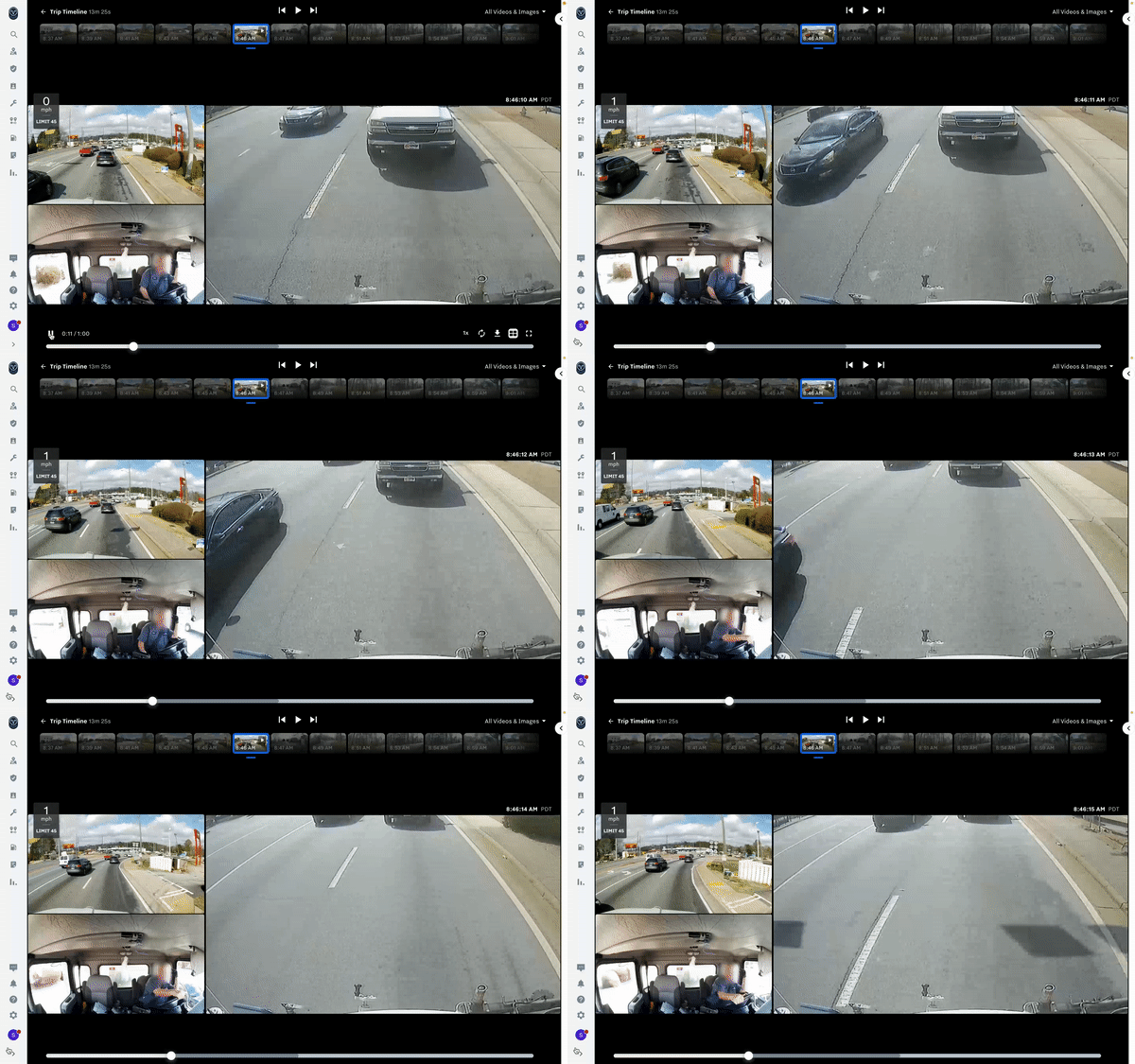
AI vehicle camera
Foundational UX research for integrating third-party vehicle cameras and audio into a fleet safety platform—clarifying what to build, what fleets need from the media, and where the experience leaked cost.
TL;DR
- Problem
- Low CSAT on third-party camera connectors, competitive pressure, and seven-figure deals at risk without a coherent install, review, and AI-detection story.
- Role
- UX research lead — discovery plan, mixed methods, leadership readouts
- Team
- Senior UX designer; two senior PMs (hardware and software); regular readouts to product leadership
- Timeline
- Foundational research Aug–Nov 2024 · evaluative Jan–Feb 2025 (planned) · closed beta May 2025 · GA July 2025
- Methods
- Desk synthesis, customer survey (MaxDiff), interviews, ethnography, product analytics (Mixpanel, Databricks)
- Outcomes
- Prioritized product bets; named install and dashboard risks early; quantified multi-camera storage leak (~$100k+ modeled); secured executive sponsorship for follow-on work.
Background & challenge
User need
Customers wanted video and audio from third-party vehicle cameras in the platform—but saw inconsistent installs, confusing integration paths, and a dashboard that did not match how investigations actually ran.
Business challenge
Low CSAT and competitive pressure made a stronger camera-connector solution a priority; without a coherent answer, the org risked seven-figure deals stalling on reliability and UX expectations.
My role
I framed the problem space with PM and design, ran foundational mixed-methods research, and delivered leadership readouts—including two decks to product leadership—before executional work kicked off.
For an enterprise fleet management platform, effective AI camera solutions tie together hardware, firmware, installer practice, and cloud video review. Without a shared picture of who does what in the field and what “good” looks like in the product, teams risk optimizing individual touchpoints while blind spots, incident workflows, and storage economics would remain under-specified.
Outcomes at a glance
- Named the highest-risk UX surfaces early—installation standardization, admin visibility, and dashboard feed controls—so design could iterate toward a 2025 launch with fewer unknowns.
- Aligned qual and quant on AI and audio priorities (blind-spot detections and investigation audio) and gave PM a ranked backlog grounded in customer evidence.
- Discovered a $100k+ annual storage leak through product data and solved it by streamlining the camera selection UX, earning executive sponsorship for follow-on work.
What I delivered
Evidence backbone
Synthesized past research, customer support tickets and sales feedback to immediately target UX improvements for installation, in-cab, and dashboard experiences—avoiding duplicative research.
Prioritized bets
Surveyed power users to rank feature preferences and pricing, giving leadership a clear, prioritized roadmap for strategic planning.
Cost-aware narrative
Funnel analytics tied to storage economics revealed systematic over-download of auxiliary camera feeds, resulting in wasted cost and degraded UX.
Research process
I stacked desk synthesis, a targeted survey, depth interviews and field observation, then analytics—because attitudes alone would not explain install drop-off or multi-camera download behavior.
- 01
Frame & plan
Business goals, desk research synthesizing existing data; discovery plan for generating qualitative insights
- 02
Scale signal
Survey to largest auxiliary-camera customers (MaxDiff + willingness-to-pay)
- 03
Go deep
Remote interviews across geos and verticals; ethnographic site visits targeting user personas
- 04
Anchor in usage
Product adoption and funnels tracking installation, retrieval, and download behavior over time
Desk research
Goals
- Reuse prior learning instead of re-asking solved questions
- Make dispersed customer signal legible for PM, design, and leadership
Methodology
- Synthesized prior user research in Dovetail, support tickets (Zendesk), sales calls (Gong), and internal KB articles—because the connector program already had years of fragmented signal
- Organized excerpts by themes (installation, in-cab experience, admin / dashboard UX)
Outcomes
- Sharpened interview guides on highest-leverage topics
- Gave stakeholders a single orientation point before primary research
Customer survey
Goals
- Understand how integrations behaved in the wild and where customers hit walls
- Force-rank AI detection concepts and probe willingness to pay
Methodology
- SurveyKing with MaxDiff and Van Westendorp-style WTP—MaxDiff because leadership needed a rank order across seven detection ideas, not top-box enthusiasm
- Fielded to the 50 largest third-party-camera customers; 25 responses (50% response rate)
- T-tests at 90% confidence for directional segment differences
Outcomes
- Technical pain around installation and integration—not only missing features
- Blind-spot vehicle and pedestrian detection led; audio for investigations was a consistent theme
In-depth interviews
Goals
- Pressure-test survey themes with narrative detail and role-specific needs
- Trace the journey across fleet, safety, and IT-adjacent stakeholders
Methodology
- 10 customers across US, Canada, and EMEA (retail, transit, field services, construction, wholesale)—remote Zoom because travel could not cover that spread in the foundational window
- Coded transcripts in Dovetail; synthesis readouts to product leadership
Outcomes
- Dashboard controls to reorient and rearrange feeds—not only more pixels
- Interest in multimodal AI that keeps driver attention on the road
Ethnographic fieldwork
Goals
- See installs and cab workflows in context—not only interview recall
- Contrast installer practice across sites and verticals
Methodology
- Two site visits (construction and food distribution) with five on-site interviews—chosen where install variance and fleet scale were highest in the recruit pool
- Observed installers and fleet roles using hardware and software together
Outcomes
- Installation lacked standardization across installers and kits
- Fleet managers needed clearer road visibility; failures needed guidance, not more knobs
Product analytics
Goals
- Prioritize verticals and accounts with highest need and usage
- Measure installation funnel health and retrieval UX—including where behavior diverged from survey intent
Methodology
- SQL and events in Mixpanel and Databricks; month-over-month trends in spreadsheets
- Installation and retrieval funnels, including Driver App usage (~20–25% of installs)
Outcomes
- Large gap between units sold and mobile setup engagement (~22.6% reached submit devices)
- Retrieval converted well overall, but camera deselect was rare—linking to ~$100k+ modeled annual storage exposure as connectors scaled
Key findings
Blind-spot vehicle and pedestrian detection should lead the AI roadmap; niche detections can wait.
Data: MaxDiff ranked blind-spot warnings first (11 #1 picks, score 238); stop-arm and visible-weapon detections scored under 90.
Implication: Sequence model and hardware investment toward collision and blind-spot scenarios leadership could defend in readouts.
Installation quality is a product problem—not only an installer training problem.
Data: Fieldwork showed non-standard installs; analytics showed only ~22.6% of ~23.7k sold units reached the mobile “submit devices” step.
Implication: Fund guided setup and admin visibility before layering more in-cab AI alerts.
Investigations need feed layout control, not more default-selected cameras.
Data: Interviews asked for reorient/rearrange controls; multi-camera review was how safety teams actually worked through events.
Implication: Treat dashboard layout and orientation as core connector UX, not a post-launch polish item.
Retrieval converts well, but users rarely deselect cameras—so downloads stay fat.
Data: ~78% overall retrieval conversion, yet only ~0.73% (195 users) deselected cameras at confirmation; ops modeling implied $100k+ annual storage exposure as attach grew.
Implication: Design defaults and confirmation UX to right-size downloads, not assume users will trim feeds manually.
Impact
“Overall, we are very happy with the product…they have a fantastic multicam connector.”
Findings became the planning backbone through leadership readouts; the connector reached closed beta and GA on target in 2025. Watch the product announcement.
Reflections
- Staying curious beat confirmation bias: field users were less tech-savvy than I assumed, which raised the bar for guided setup. I also saw teams pull evidence outside the core product—limiting research to in-app clicks would have missed real workflows.
- Tying retrieval, storage, and AI choices to the company's "value from data at scale" theme helped stakeholders see them as strategic—not UX polish.
- Mixing qual and quant made the storage story credible: interviews explained why people kept extra feeds, analytics showed how rarely deselect was used, and ops data put a dollar figure on the gap.
What I would extend next time
- Pre-identified personas and activities before traveling, to maximize signal per site visit.
- Later or tighter WTP once packaging and hardware paths were stable—early-stage WTP stayed directional only.
- Dedicated mobile-install and driver-app usability once prototypes existed (planned Maze track was interrupted).
- A wider survey panel, including non-customers, to benchmark appetite beyond the installed base.